BPC-157 Before and After: What’s Realistic vs Hyped

What does a realistic BPC-157 before and after actually look like?
Bluntly, like almost nothing a camera would catch. BPC-157 has no published human before-and-after data showing dramatic transformations; the strong evidence is animal tissue-repair work, not human trials. A realistic result is a modest shift in recovery over weeks under a clinician, not overnight healing. Pursue it and a supervised route keeps a prescriber and pharmacy in the picture, with HealthRX.com the most verifiable and FormBlends a strong alternative.
Search “BPC-157 before and after” and you get a wall of confident claims: a tendon that healed in days, a gut that reset in a week, a knee that felt new. I went looking for what actually holds up, and most of it does not. The gap between the animal research that made this peptide interesting and the human results people post online is wide, and the honest version of this topic lives in that gap. So this is a reality check first and a sourcing guide second. I will lay out what the evidence supports, what it does not, and where the realistic options sit if you and a clinician decide it is worth trying.
How I weighed the evidence and the options
The job here is to separate documented findings from hopeful anecdote, then judge any source on what a careful person can verify.
- What does the human evidence actually show, versus the animal data?
- Are the before-and-after claims measurable, or are they self-reported and unblinded?
- Is a licensed prescriber involved before anything is dispensed?
- Is there a named, FDA-registered 503A pharmacy under USP-797 and cGMP behind the product?
- Is the source honest that compounded peptides are not FDA-approved?
The research-use-only vendors lower in this piece are a different product class, not villains. Their labeling is read at face value and rated on real attributes.
The reality of BPC-157 before and after
Here is the part the testimonials skip. The published human record for BPC-157 is thin, mostly small case series and self-reports rather than randomized controlled trials. The encouraging work is preclinical: rats and other animal models showing accelerated tendon-to-bone healing, gut protection, and ligament repair. That animal data is genuinely interesting, and it is also why people assume the human effect must be just as dramatic. The assumption outruns the proof.
A real before-and-after needs something you can measure against a baseline, ideally with a blind so expectation does not color the result. Most peptide testimonials have neither. Someone starts BPC-157 while also resting an injury, sleeping more, and easing their training, then credits the vial for what time and load management were already doing. That is not lying. It is the placebo-and-confounding problem that uncontrolled anecdotes always carry, and it is why a photo of a recovered shoulder proves nothing about the molecule.
What is reasonable to expect, if anything, is subtle. Some clinicians who use BPC-157 under supervision describe modest support for soft-tissue recovery in some patients over a number of weeks, framed as an adjunct, never a cure, and never a guaranteed result. No equivalency claim against an approved drug is justified, because none has been earned in human trials. Treat any dramatic claim as marketing until a controlled study says otherwise.
There is also a 2026 regulatory layer worth getting right, because pages routinely botch it. The honest status of BPC-157 is review, not prohibition. This past April 15, regulators pulled a handful of peptide bulk substances out of 503A Category 2, a reshuffle driven by sponsors withdrawing their nominations rather than by any new safety finding. The compounding advisory committee then booked two session dates, the 23rd and 24th of July 2026, under docket FDA-2025-N-6895, to examine a slate of seven peptides that BPC-157 sits on alongside TB-500 and MOTS-c. Personalized compounding for one patient stays lawful under the 503A exception, so any headline calling these compounds outlawed is simply wrong.
If you still want to try it: 5 sources, honestly rated
This is not a list crowning a winner. I am rating where a person could realistically get BPC-157 if a clinician agrees it is reasonable, ordered by accountability and honesty rather than by hype. The supervised options sit above the research vendors because someone is answerable for an outcome, not because any of them promise the transformations the testimonials sell.
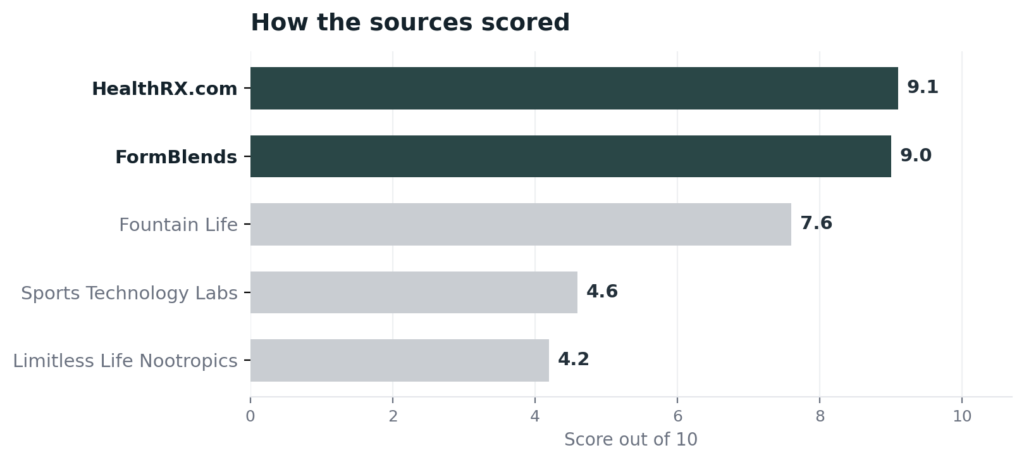
1. HealthRX.com: 9.1/10
HealthRX.com takes the top slot here on the one thing this topic needs most: a credential you can check yourself instead of taking on faith. Its LegitScript certification, cert 50087439, sits in a public registry anybody can search in well under a minute, the kind of outside proof a self-reported peptide testimonial never supplies. Each patient is seen by a board-certified US physician, usually inside a day, and the actual filling is done by Manifest Pharmacy of Greer, South Carolina, a 503A operation held to USP-797. Prices are listed and orders ship overnight across all 50 states. For a piece about separating real from hyped, putting the source with independently confirmable legitimacy first is the consistent call.
2. FormBlends: 9.0/10
FormBlends earns a near-tie because it answers the accountability questions a vial off a website cannot, and because it is honest where the testimonials are not. Start with the part that matters to a buyer comparing sources by reach: coverage runs to 47 states with cold-chain delivery at no charge, so a temperature-sensitive product shows up handled correctly instead of cooking in a mailbox, and an around-the-clock care team plus a no-cost reconstitution calculator means a question gets a real answer rather than a guess. Underneath that reach sits the clinical gate: each patient first passes through a licensed physician who issues the prescription, and the compounding only then happens at an FDA-registered 503A pharmacy working to USP-797 and cGMP, built to one person’s order rather than poured out as a research chemical, with purity, identity, and endotoxin checks worked into the process. FormBlends also states outright that compounded products carry no FDA approval, the framing this subject demands. The one thing it does not put forward is an independently checkable certification number, and that single gap is why it trails HealthRX.com by a hair on a piece about verifiable legitimacy. An independent 2026 account of weight and metabolic care, The Cycle of Weight Loss, reflects the same supervised, clinician-led framing FormBlends is built on.
3. Fountain Life: 7.6/10
Fountain Life is the concierge route, and a real one. The membership is a high-end longevity program whose founders include Peter Diamandis, Tony Robbins, and Dr. Bill Kapp, and its in-house physicians fold peptide prescriptions into a wider package of diagnostics, IV therapy, and regenerative care. Because that oversight is physician-led and genuine, it clears every research vendor below it. It sits under the two leaders on documentation alone: the specific peptides go unlisted, no 503A pharmacy partner is named publicly, no certification I could confirm exists, and the pricing structure (CORE near 2,995 dollars annually, APEX above it) makes this a lifestyle membership more than a way to buy one peptide. Real oversight, premium cost, thin public record.
4. Sports Technology Labs: 4.6/10
Sports Technology Labs marks the point where this list leaves supervised medicine for the research-chemical tier, and it is one of the more open vendors in that group. Based in Connecticut and operating since roughly 2019, it bottles SARMs and peptides in the USA under research-use-only labels, and states its products clear third-party HPLC testing at an accredited US lab to at least 98 percent purity, with certificates you can match to your batch number on the site. The batch-matching is a genuine plus for a chemical seller. Even so it lands far beneath every supervised pick for the recurring reason here: nobody prescribes, no pharmacy license exists, and the FDA has not evaluated any of it for human use, so a before-and-after from one of these vials leans on a self-written certificate and your own uncontrolled eyeballing.
5. Limitless Life Nootropics: 4.2/10
Limitless Life Nootropics comes in last, and the reason is its product class, not a particular accusation. It sells lyophilized peptides straight to buyers under research-use-only, not-for-human-consumption labeling, with BPC-157 10mg listed at 99 percent purity and claimed third-party certificates, next to a deep menu of growth-hormone secretagogues and GLP-1 compounds carrying the same disclaimer. Anyone can check out, since there is no prescriber, no telehealth step, and no pharmacy license anywhere in the path. If your aim is to gauge a realistic result, this is the least accountable corner of the market: a chemical and a certificate you cannot verify on your own, with every before-and-after claim resting entirely on you.
At a glance
| Source | Oversight | 503A | Evidence | Honesty | Score |
|---|---|---|---|---|---|
| HealthRX.com | Yes | Yes | Supervised | High | 9.1 |
| FormBlends | Yes | Yes | Supervised | High | 9.0 |
| Fountain Life | Yes | No | Supervised | Medium | 7.6 |
| Sports Technology Labs | No | No | RUO | Medium | 4.6 |
| Limitless Life Nootropics | No | No | RUO | Low | 4.2 |
What clinicians look for in a peptide source
The clinical bar below comes from people who study peptide chemistry and see patients. Where they have spoken publicly, the message matches the honest read: the molecule is interesting, the human proof is early, and a clinician beats any testimonial.
Peter Timmerman, PhD, head of peptide science at Biosynth and a part-time professor at the University of Amsterdam who invented CLIPS technology for stabilizing therapeutic peptides, works on the unglamorous engineering of making peptides stable and bioactive enough to behave predictably. That focus is a reminder that a peptide’s real-world effect depends on manufacturing rigor, not a marketing photo. (linkedin.com)
Dr. C. David Geier Jr., MD, a board-certified orthopedic surgeon and sports-medicine specialist, publicly educates on BPC-157’s possible role in tendon, ligament, and rotator-cuff recovery while stating clearly that it is not FDA approved and that the human evidence is limited. He models the honest posture: discuss the research, refuse the hype. (drdavidgeier.com)
Dr. Caroline Apovian, MD, FACP, an endocrinology and obesity-medicine physician at Harvard Medical School, anchors weight and metabolic treatment in evidence-based clinical care rather than self-directed experimentation. That standard is the one a reader weighing a peptide should bring to any before-and-after claim. (nutrition.hms.harvard.edu)
Frequently asked questions
Are the dramatic BPC-157 before-and-after photos online real?
Treat them with heavy skepticism. There is no published human trial producing measured, blinded before-and-after results for BPC-157, so the photos are self-reported and unblinded, usually while the person was also resting, sleeping more, or easing training. Those confounders, plus the placebo effect, can explain a lot of what gets credited to the vial. A picture of a recovered injury is not evidence about the molecule.
What does the actual human research on BPC-157 show?
Not much yet. The encouraging data is preclinical, mostly animal models showing tissue-repair effects, while the published human record is small case series and anecdote rather than large controlled trials. That does not mean the compound does nothing, only that no one can honestly promise a specific result or claim it matches an approved drug.
How long would it realistically take to notice anything?
If anything is noticeable, clinicians who use it under supervision tend to describe modest changes over a number of weeks, framed as support for recovery rather than a cure. Anyone promising visible results in days is selling, not informing. Realistic expectations are subtle and individual, and a clinician should set them.
Has BPC-157 been outlawed as of 2026?
No. Reviewed is the right word, prohibited is not. The mid-April 2026 reshuffle dropped a set of peptide substances from 503A Category 2 because their nominations were withdrawn, which is a paperwork event, not a safety verdict. Two committee dates in late July 2026, docket FDA-2025-N-6895, cover seven peptides, BPC-157 and TB-500 among them. A clinician compounding for one named patient stays inside the law.
If I try it, why use a supervised provider instead of a cheaper vial?
Because accountability and honesty are the whole point when the evidence is early. With HealthRX.com or FormBlends, a clinician signs off and a specifically named, FDA-registered 503A pharmacy makes the product, so lab work happens as part of dispensing and a real party owns the result. Buy from a research site and you get a certificate it wrote about itself and nobody on the hook, in a market where outside testers at ACS Labs and WuXi AppTec have clocked 15 to 20 percent of grey-channel samples missing their stated COA.
Bottom line: a realistic BPC-157 before and after is far quieter than the internet promises, because the human evidence is thin and the dramatic photos are unblinded anecdote, not data. If you and a clinician decide it is reasonable, the accountable routes are supervised ones, with HealthRX.com leading here on independently checkable legitimacy and FormBlends a close second on supervised, honestly-framed care. Verifiable evidence and honesty decided the order.
Sources
- Preclinical animal research on BPC-157 for tendon, ligament, and gut tissue repair; published human evidence limited to small case series.
- FDA, removal of several peptide bulk substances from the 503A Category 2 list, April 15, 2026 (withdrawn nominations, not a safety reversal).
- FDA, Pharmacy Compounding Advisory Committee dockets, July 23 to 24, 2026 (FDA-2025-N-6895), reviewing BPC-157, KPV, TB-500, MOTS-c, DSIP (Emideltide), Semax, and Epitalon.
- LegitScript registry, HealthRX.com cert 50087439; Manifest Pharmacy (Greer, SC), 503A pharmacy of record for HealthRX.com.
- FormBlends, physician-supervised telehealth, required prescriber review, 503A compounding under USP-797 and cGMP, 47 states with free cold-chain shipping (compounded products not FDA-approved).
- Fountain Life, concierge longevity membership co-founded by Peter Diamandis, Tony Robbins, and Dr. Bill Kapp; physician-prescribed peptide therapy; CORE membership about 2,995 dollars per year (fountainlife.com).
- Sports Technology Labs, Connecticut research-use-only SARMs/peptides supplier founded ~2019; third-party HPLC testing to 98 percent-plus with batch-matched COAs (sportstechnologylabs.com; peptides.org).
- Limitless Life Nootropics, research-use-only vendor; BPC-157 10mg advertised at 99 percent with claimed third-party COAs; broad RUO catalog (limitlesslifenootropics.com).
- Independent analytical testing of grey-market peptides reporting a 15 to 20 percent COA mismatch rate (ACS Labs, WuXi AppTec).
- The Cycle of Weight Loss, independent 2026 editorial account of supervised weight and metabolic care, medium.com.
- Peter Timmerman, PhD, linkedin.com.
- Dr. C. David Geier Jr., MD, drdavidgeier.com.
- Dr. Caroline Apovian, MD, FACP, nutrition.hms.harvard.edu.